

“Render Unto Caesar”: Jesus and the Sacred Limits of State Power
What we owe to the state and what we owe to God

The double-headed eagle is perhaps the most recognizable insignia of the late Eastern Roman Empire. While there are different variations of the emblem, one of the subtleties of the image lies in the objects clasped within the eagle’s talons: The sword and the globus cruciger, representing the imperial power of the state, and Christ’s dominion over the world. Both are instruments of divine authority, both are mutually counterbalancing, and both are necessary for the legitimacy of rule. The Church and the State are meant to work in concert with each other as mutually cooperative pillars supporting the establishment of God’s kingdom on Earth, rather than institutions locked in perpetual conflict over souls. The principle of subsidiarity in Catholic social teaching expands on this, identifying that each institution, religious or otherwise, occupies its own legitimate sphere of influence and should operate within these bounds, working in harmony with the domains of other institutions as part of an interconnected yet autonomous social order.
While these principles are clear, the applications of these principles are not always clear. Scripture does not provide a ready-made answer to every contemporary political question, but it does offer a foundational anthropological framework from which to operate. No one in the Bible more clearly articulates this framework than Jesus Christ in His famous dialogue with the Pharisees on whether Jews should pay taxes to Caesar.
Matthew 22:15-22:
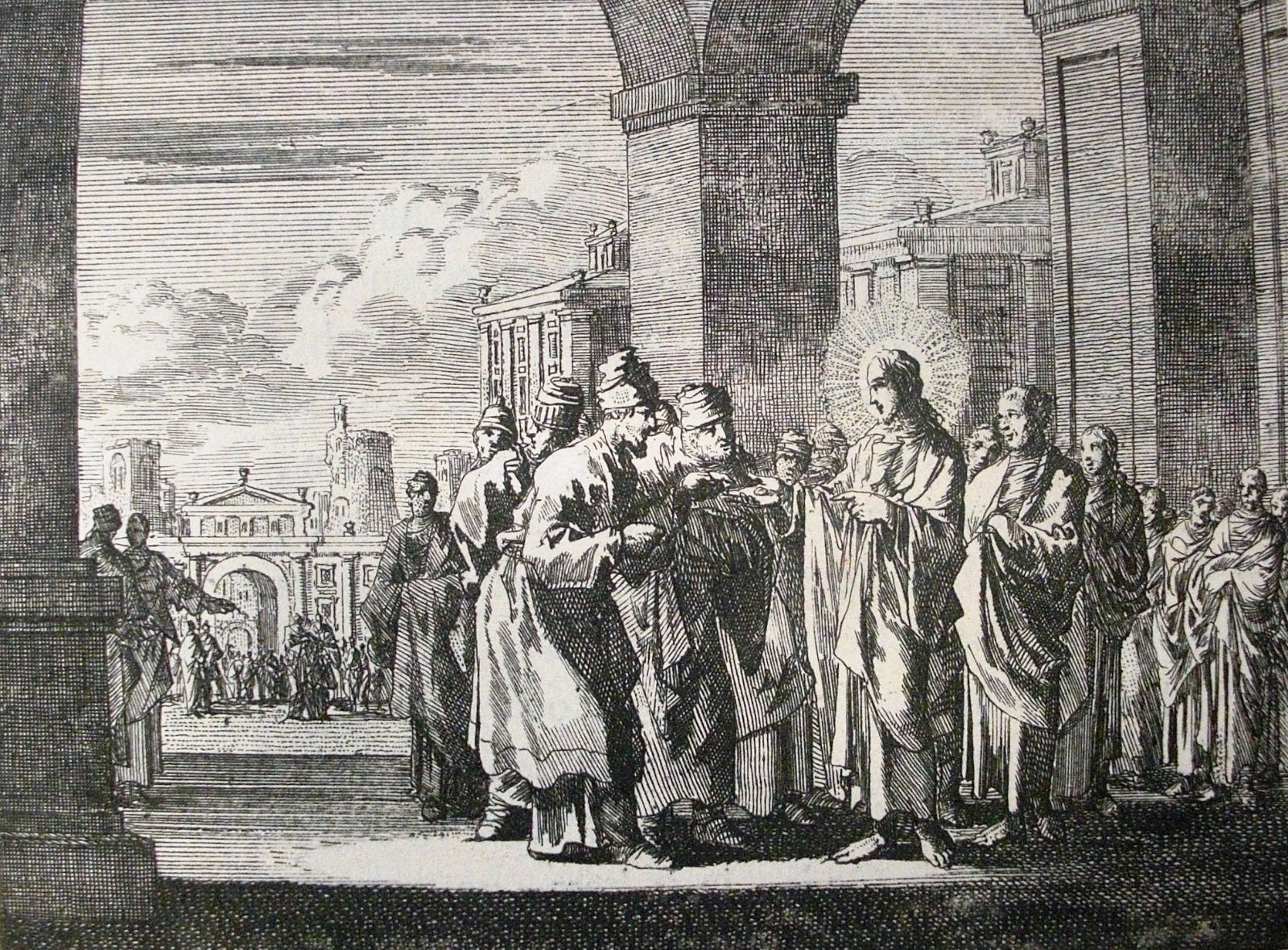
Then the Pharisees went and plotted how they might entangle Him in His talk. And they sent to Him their disciples with the Herodians, saying, “Teacher, we know that You are true, and teach the way of God in truth; nor do You care about anyone, for You do not regard the person of men. Tell us, therefore, what do You think? Is it lawful to pay taxes to Caesar, or not?” But Jesus perceived their wickedness, and said, “Why do you test Me, you hypocrites? Show Me the tax money.” So they brought Him a denarius. And He said to them, “Whose image and inscription is this?” They said to Him, “Caesar’s.” And He said to them, “Render therefore to Caesar the things that are Caesar’s, and to God the things that are God’s.” When they had heard these words, they marveled, and left Him and went their way.
Judea during the time of Christ was home to immense political strife, with the Jews enduring a long series of subjugations and persecutions, the latest of which was under the Roman Empire. A particularly contentious issue amongst the Pharisees was whether paying taxes to Caesar constituted religious idolatry. The Pharisees, looking for a reason to arrest Jesus, had crafted what they believed to be an impossible dilemma by asking him if Jews should pay taxes to Caesar. A “yes” would lead to Jesus being branded a traitor to His people, a “no” would risk Jesus facing charges of sedition against Rome, and a refusal to answer would have tarnished His reputation and trustworthiness as a teacher.
Jesus, however, was privy to their schemes and understood that their inquiries were not merely about taxation, but rather about earthly authority over God’s people. With just two sentences, Jesus provides groundbreaking insight into the nature of authority, citizenship, and the human person’s relationship to both earthly and heavenly powers.
“Whose Image and Inscription is This?” - Matthew 22:20
While the Pharisees were correct in identifying the image on the denarius to be Caesar, Jesus was doing far more than making a basic observation about currency. In Rome, the denarius didn’t merely bear Caesar’s likeness; it also had an abbreviation of the term: “TIBERIUS CAESAR DIVI AUGUST FILI AUGUSTUS,” or “Tiberus Caesar, Worshipful Son of the God, Augustus.” On the other side of the coin was the Roman Goddess of peace, Pax, with a form of the word: “PONTIFEX MAXIMUS,” or “high priest.”
The Pharisees were well-versed in the Shema and the Ten Commandments, which forbade worship of false gods and the creation of graven images. Yet, they used coins that invoked the emperor as both the son of god and high priest and featured a pagan goddess, in the Temple, the most sacred place on Earth, every single day. The Pharisees had already compromised with the very system they challenged by carrying coins that proclaimed Caesar as god and high priest daily, and Jesus exposed their hypocrisy before He said another word.
By then asking the question of whose image appears on the coin and subsequently invoking God in conjunction with Caesar in response, Jesus indirectly forces consideration of the question: The coin bears Caesar’s image, but who bears God’s image? Genesis 1:27 answers that question for us: Humanity itself.
“Let every soul be subject to the governing authorities. For there is no authority except from God, and the authorities that exist are appointed by God.” - Romans 13:1
Mankind being made in the image of God undergirds all Catholic social teaching and serves as the foundation for a moral vision of society. All humans are born with an intrinsic dignity that is sacred and immutable, and not granted or licensed to them by any temporal authority. This fact of humanity’s existence is precisely why Catholics are obligated to oppose moral injustice and uphold moral virtue and truth in both their private and public lives.
This dignity applies to all civil leaders and governing authorities, including the unpopular ones. The Catechism of the Catholic Church states that those subject to authority should regard civil leaders “as representatives of God, who has made them stewards of His gifts.” While some may interpret Jesus’ refusal to answer the question as an endorsement of not paying taxes, this is nowhere indicated in the passage. If that were the case, He would not have ordered St. Peter to pay the temple tax in Matthew 17:24-27. Jesus commands His disciples to pay the tax, not because He politically endorses it, but because He recognizes that paying taxes is a component of fulfilling one’s civil duties. Justice, as defined by Catholic social teaching, is rendering to “each and to all what belongs to them,” and, as St. Paul states, “Render therefore to all their due: taxes to whom taxes are due, customs to whom customs, fear to whom fear, honor to whom honor.” Paying one’s taxes, then, is an act of justice because the social order is part of God’s design for political society.
To quote St. Ambrose: “If you would not be indebted to Caesar, do not possess what belongs to the world. You have wealth; therefore you are indebted to Caesar. If you want to owe nothing to an earthly king, leave all that you have and follow Christ.”
“But Peter and the other apostles answered and said: “We ought to obey God rather than men.” - Acts 5:29
While Jesus rules out anarchism, Christians aren’t obligated to give blind obedience to the government when it engages in morally objectionable activity in every context. According to Catholic social teaching, the legitimacy of any institution depends on the degree to which it “threatens or enhances the life and dignity of the human person.” Citizens and their governing authorities have a co-responsibility to contribute to the common good, and obedience to said authorities is contingent on the degree to which they do so.
Pope Leo XIII in Immortale Dei states that it is the role of government to “ensure the general welfare,” and all civil authorities must “bear in mind that God is the paramount ruler of the world and must set Him before themselves as their exemplar and law in the administration of the State.” God has ordained that two powers govern the human race: the “ecclesiastical and the civil, the one benign set over Divine, and the other human… each in its kind its supreme, each has fixed limits within which it is contained” such that there is an “orbit traced around within which the action of each is brought into play by its own native right.” In other words, ecclesial and civil powers are both divinely ordained and serve distinct yet complementary roles. Catholic social teaching builds on this, favoring a limited government that conducts its affairs in a manner proportionate to its proper ends, which is promoting and facilitating the common good for its constituents.
In short, the reasons why Christians have a duty to obey civil authorities and the reasons why civil authorities have a duty to advocate for the common good politically are the same: both groups are made in the image of God and have a mutual responsibility to honor the imago Dei in one another.
To quote Norman Horn: “Submission to civil government, then, is always qualified. The command is to obey in general, but sometimes we will disobey public policy because of personal and Scriptural conviction. Christians are to obey most policy whenever directly requested to do so, but ensuring active compliance with every public policy is unnecessary. All submission is directed at being expedient and practical toward men and glorifying toward God.”
“Render therefore to Caesar the things that are Caesar’s and to God the things that are God’s.” - Matthew 22:21
Christ was not baptizing Caesar’s authority with the charism of infallibility, but He was not teaching that civil power and authority are exercised in a moral vacuum apart from God, either. Whether it is a Catholic theocracy, pagan empire, or a liberal republic, Christ shows that the underlying principle behind all of them remains: Civil authority, while legitimate and serving a real purpose in God’s design and thus must be followed, is subordinate to God’s sovereignty, and its moral claims must be evaluated by how it upholds human dignity. It is a citizen’s duty to submit to it insofar as it governs in a manner congruent with the common good and oppose it when it does not do so.
The forms of Christian opposition to unjust laws can take several different forms. Christians can oppose statutes that require them to violate their religious convictions, but on a practical level, that doesn’t mean people should resort to civil disobedience at the outset of every political grievance. As St. Paul teaches: “Do not be overcome by evil, but overcome evil with good.” After all, if Jesus truly meant that Christians should not have any relation with the secular world, or that we should recuse ourselves from our civil duties under the pretext that higher authorities do not always act in accordance with the teachings of Christ, then there would be no hope for its conversion.
What separates modern liberal democracies from governments of the past, however, is that we can tell Caesar how much we render unto him. This is precisely why Christians are called to “voice their just criticisms of that which seems harmful to the dignity of persons and to the good of the community.”
Ultimately, Jesus’ famous “render unto Caesar” dialogue instructs Christians to be good citizens by obeying the law, respecting earthly authorities, and, indeed, paying taxes. However, the state is also not an idol to be worshipped. Man’s first allegiance lies with God, who is the ultimate source of all liberty and freedom. When the state opposes those ends, then Christians should first express their opposition within the framework of legitimate legal processes, voice just criticisms, and advocate for policies that uphold human dignity and the common good. Outright civil disobedience should be exercised only when necessary.
Political legitimacy is contingent upon whether the delicate balance between temporal authority and divine authority is maintained. When it is not, all of us would do well to remember that obedience to God must take precedence over obedience to Caesar. Jesus is the Son of God, the high priest, and the ruler of the world, not Caesar.
Tyler Turman is an alumnus of the Acton Institute’s Emerging Leaders Program. He earned degrees in political science and economics from the University of Washington and is a Research Associate at a DC-headquartered policy organization.
 | A guest post by
|